GEO vs SEO, What Changes When an AI Writes the Answer
What the 2024 GEO research paper tested, what Google says about AI Overviews, and which crawlers decide whether ChatGPT and Perplexity can cite your pages.
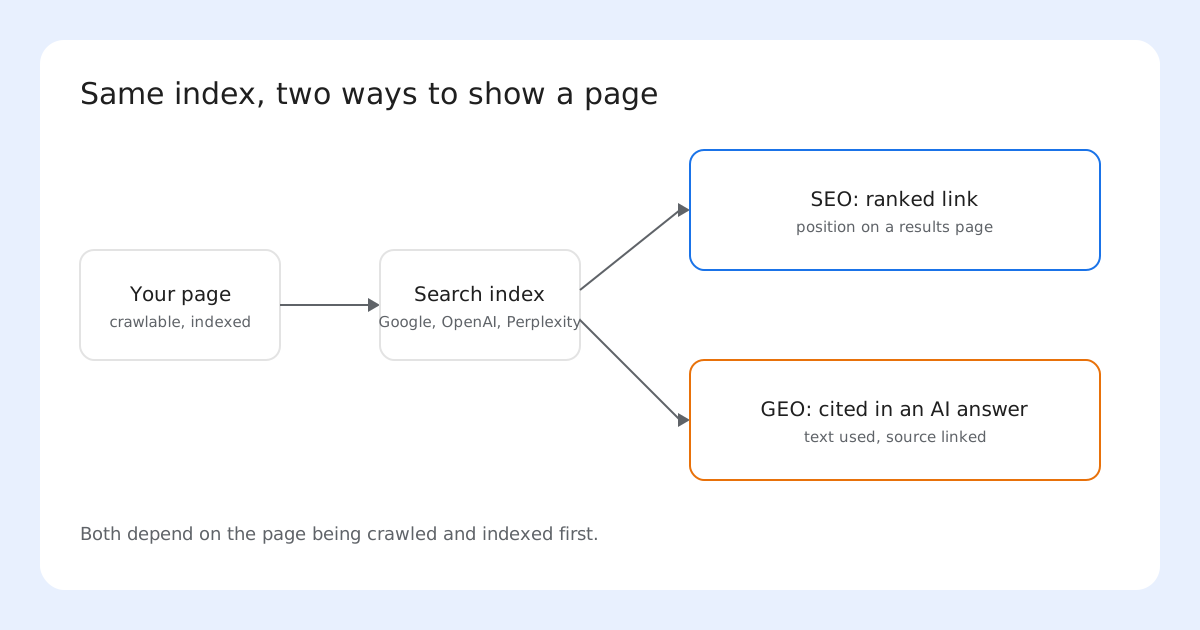
GEO, short for generative engine optimization, is the work of getting a page cited in answers written by AI search tools such as Google AI Overviews, ChatGPT search and Perplexity. SEO aims for a ranked link on a results page. GEO aims for a mention or a source link inside a generated answer.
Most of the work overlaps. An AI search tool can only cite a page it has fetched, and the main tools pick their sources from a search index. The differences are in how a page's text gets used once it is selected, and in which crawlers you allow.
Where the term comes from
The term comes from the paper GEO: Generative Engine Optimization by Pranjal Aggarwal and five co-authors, first posted in November 2023 and published at KDD 2024. The authors built a test engine that fetched the top 5 Google results for a query and had gpt-3.5-turbo write an answer from them. They then rewrote one source page at a time and measured how much of the answer drew on that page.
Their benchmark, GEO-bench, has 10,000 queries across 25 domains. They tested nine rewriting methods:
- Cite Sources
- Quotation Addition
- Statistics Addition
- Authoritative
- Easy-to-Understand
- Fluency Optimization
- Unique Words
- Technical Terms
- Keyword Stuffing
Cite Sources, Quotation Addition and Statistics Addition did best, with relative improvements of 30% to 40% on the paper's main visibility measure. Keyword Stuffing did not perform well and scored slightly below the unedited pages. The authors report improvements of up to 37% when they repeated the tests on Perplexity.
Two limits matter when you apply this. The test engine was a 2023 model reading five pages, not the systems Google or OpenAI run today. And the paper notes that how well each method worked varied by subject area.
What Google says about AI Overviews
Google's guidance on AI features and your website says there are no additional requirements or special optimizations for AI Overviews or AI Mode. A page needs to be indexed and eligible to be shown in Google Search with a snippet. Google also says you do not need new machine-readable files, AI text files or special schema.org markup to appear.
The controls are the ones that already apply to search results. nosnippet, data-nosnippet, max-snippet and noindex limit what Google can show from a page. Google-Extended is a separate setting that limits use of your content for AI training and grounding in some of Google's other systems; Google's page does not describe it as a control for Search.
Crawlers decide who can cite you
For ChatGPT and Perplexity, the robots.txt rules for their crawlers decide whether your pages can appear. Each company runs separate crawlers for search and for model training, so you can allow one and block the other.
| Crawler | Used for | Blocking it means |
|---|---|---|
| OAI-SearchBot | Showing sites in ChatGPT search | Your pages are not shown in ChatGPT search answers, though they can still appear as navigational links |
| GPTBot | Training OpenAI's models | Your content should not be used for model training |
| ChatGPT-User | Fetching pages when a ChatGPT user asks | OpenAI says it is not used to decide what appears in search |
| PerplexityBot | Showing and linking sites in Perplexity search | Perplexity cannot use it to surface and link your pages in search |
| Perplexity-User | Fetching a page to answer a user's question | Perplexity says it generally ignores robots.txt because a user asked for the page |
Sources: OpenAI crawler documentation, Perplexity crawler documentation. OpenAI notes that robots.txt changes can take about 24 hours to apply to search.
Blocking AI crawlers with one blanket rule to keep content out of training also removes the site from ChatGPT and Perplexity search. If you want to be cited but not trained on, allow OAI-SearchBot and PerplexityBot and block GPTBot.
What to change on a page
Start with the SEO basics, because the AI search tools above depend on them: the page has to be crawlable, indexed and allowed to show a snippet. Then check robots.txt against the table.
After that, the paper's three best methods describe writing that is easy to quote:
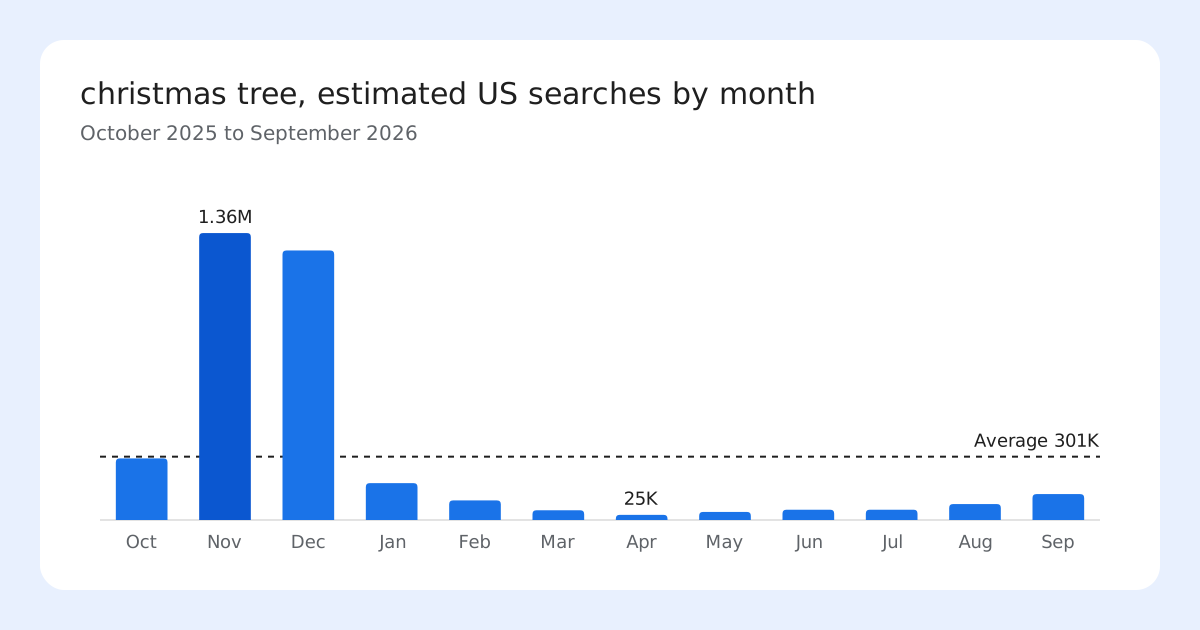
- State numbers with their source and date, for example "christmas tree averaged 301,000 US searches a month between October 2025 and September 2026."
- Link to the primary source for each claim rather than a summary of it.
- Include short direct quotations from named people or documents where they support the point.
Repeating the target keyword more often, the older SEO habit the paper calls keyword stuffing, did not help in its tests.