Why Keyword Tools Show Different Search Volumes for the Same Keyword
We compared two search volume sources across 709 US keyword reports. They agreed within 25% only a quarter of the time, and question-style keywords disagreed the most.
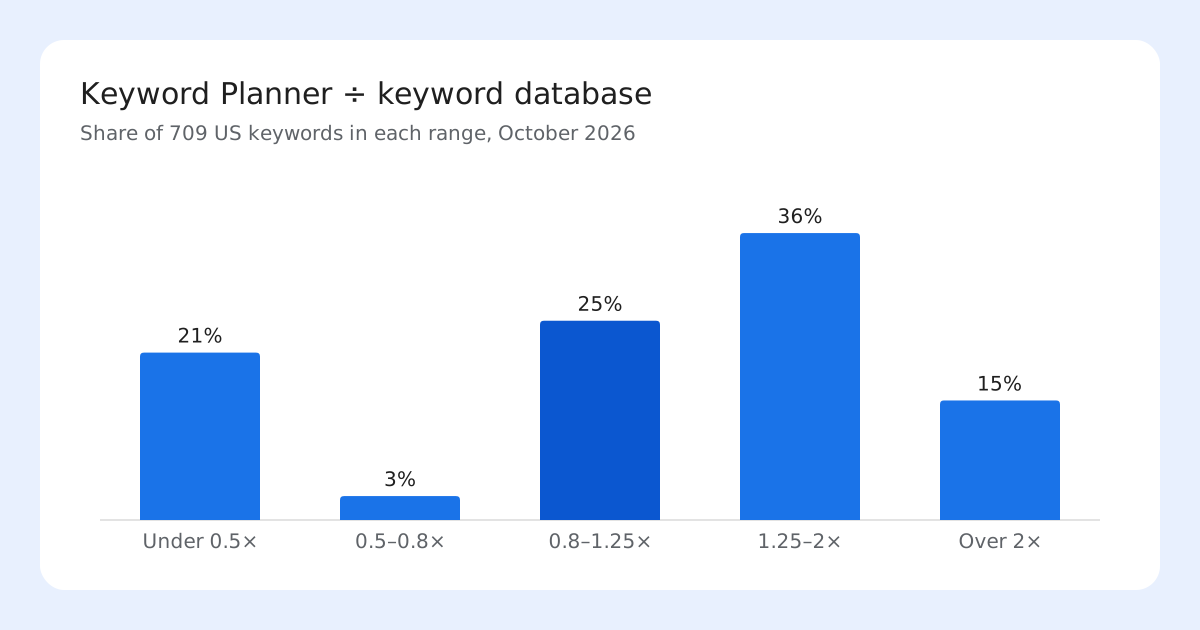
KWS Trends reports show two search volume numbers for each keyword: the average monthly searches from a third-party keyword database, and the average monthly searches from Google Ads Keyword Planner. We compared them across 709 US reports collected between October 26 and 28, 2026. The two numbers were within 25% of each other for 175 keywords, about a quarter of the set.
How far apart the two numbers were
We divided the Keyword Planner number by the database number for each keyword. A ratio of 1 means they match.
| Keyword Planner compared with the database | Keywords | Share |
|---|---|---|
| Less than half | 151 | 21% |
| 50% to 80% | 24 | 3% |
| Within 25% either way | 175 | 25% |
| 1.25 to 2 times | 255 | 36% |
| More than 2 times | 104 | 15% |
The median ratio was 1.49, so for a typical keyword Keyword Planner reported about one and a half times the database figure. Exact matches were rare: 43 of the 709 keywords had the same number from both sources.
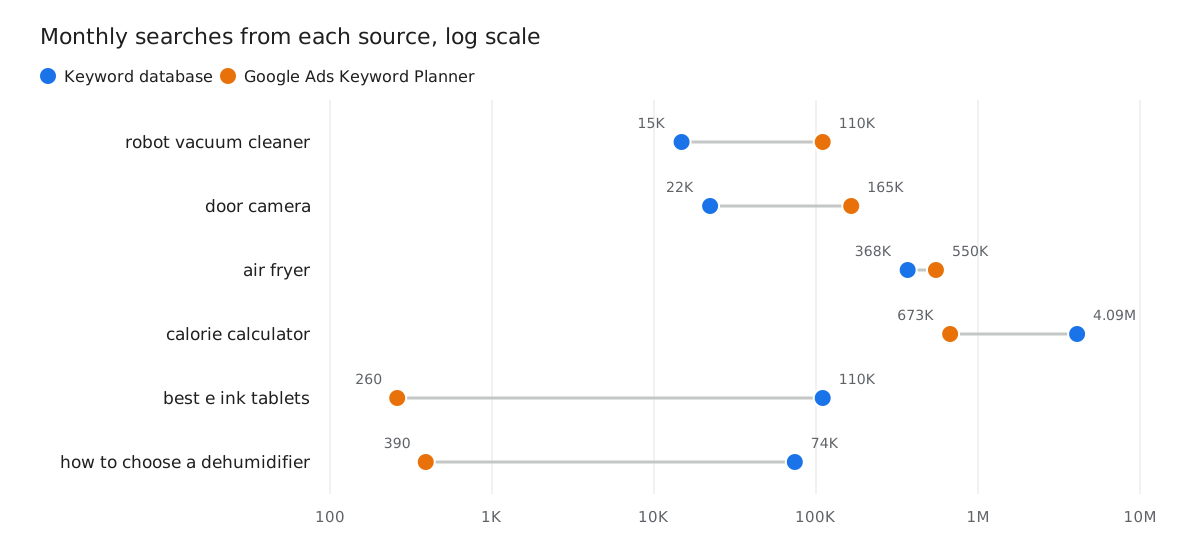
Some of the gaps in the full set, from the reports for robot vacuum cleaner, door camera, air fryer, calorie calculator, best e ink tablets and how to choose a dehumidifier:
Question-style keywords disagree the most
The keywords where Keyword Planner reported less than half of the database number had something in common. Of those 151 keywords, 95 (63%) started with how, what or best. Among the 175 keywords where the two numbers were within 25%, that share was 9%.
Looked at the other way, 128 keywords in the set start with how, what or best. For 95 of them (74%), Keyword Planner reported less than half the database figure. For the other 581 keywords, the same happened 10% of the time.
The numbers alone do not say which source is closer to the real count for these keywords. They do say that a database figure of 74,000 for a five-word "how to" query should be checked before you plan a page around it.
Why the sources count differently
Google defines Keyword Planner's figure as "the average number of times people have searched for a keyword and its close variants," averaged over 12 months by default for the location and network you choose (Google Ads Help). Google also says these statistics are rounded. Both sources in our reports use the same set of rounded steps (9,900, 12,100, 14,800, 18,100 and so on), so two keywords with slightly different demand often show the same number.
A third-party database does not see Google's search logs. It builds its estimate from its own data and models, and it reports a rolling 12-month average without saying exactly which months it covers. How it groups close variants is not published. In our set, keywords that do not start with how, what or best had a median ratio of 1.49, so Keyword Planner was usually the higher source for short product and tool keywords. For long, specific phrases the database figure can include demand that Keyword Planner assigns to other phrasings, or the reverse; neither source publishes enough detail to tell which happened for a given keyword.
What to do with two numbers
Compare keywords using one source at a time. If you rank keywords for a content plan, a list sorted by database volume and a list sorted by Keyword Planner volume can both be useful, but a list that mixes the two is not.
For long question-style keywords, treat the database number as an upper estimate until something else supports it. Two checks are available without paid tools:
- If your site already ranks for the keyword, Google Search Console shows impressions. A page in the top 10 for a keyword with 74,000 monthly searches would show thousands of impressions a month.
- Compare the keyword in Google Trends with a keyword whose volume you trust. If the trusted keyword has 40,000 searches and the question keyword's line sits far below it, the question keyword is unlikely to have 74,000.
Each KWS Trends report keeps both numbers side by side for this reason. The methodology page lists which figures on a report come from which source.